
Agnès Gleizes Gives Us a Grand Tour of Premier Cru Chablis Terroir
Agnès Gleizes and her partner Cyril Gautheron lead a family-run estate in Chablis that stretches back seven generations. Based in the village of Fleys, just a few kilometers from the town of Chablis, they manage about 30 hectares of vines spanning Petit Chablis, Chablis, Premier Cru, and even Grand Cru appellations.
Their philosophy is firmly rooted in terroir: they allow soil, exposure, vine age, and vintage to shine through rather than imposing heavy-handed techniques. They farm with high environmental standards—they are certified HVE level 3 (“Haute Valeur Environnementale”), its highest tier, underlining their commitment to sustainability.
Their wines typically show clarity, minerality, and freshness. Their Chablis wines often bear citrus, floral, and orchard fruit notes, lean toward a clean, incisive acidity, and brim with that hallmark chalky/flinty minerality of Kimmeridgian soils. Their Premier Crus (for example 2023 Agnes Gleizes Chablis 1er Cru "Vaucoupin" $34.99 90-92JM or 2023 Agnes Gleizes Chablis 1er Cru "Les Fourneaux Vieilles Vignes" $34.99 91-94JM 93TA 90VN) build upon that framework with greater depth, texture, and layered complexity, especially with older vines—and they represent a tremendous value. We have seven different Premier Cru bottlings in stock right now, and it’s the perfect opportunity to journey through the complex, delicious world of Chablis!
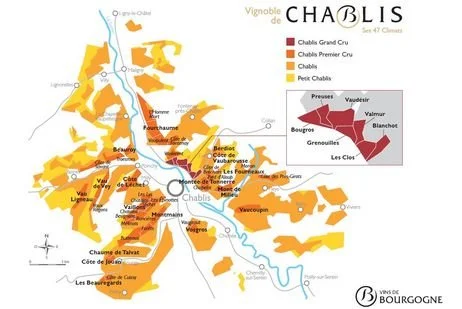
Chablis’ Premier Crus are a mosaic of limestone, clay, and sunlight, strung along the cool banks of the Serein River. Forty named climats make up this network, each expressing a slightly different facet of Chardonnay grown on Kimmeridgian soil—the ancient seabed that gives Chablis its unmistakable minerality.
On the right bank near the Grand Crus lies Montée de Tonnerre, a vineyard revered for producing wines of finesse and power. Its slopes face southwest, catching the warmth of the sun yet grounded by stony marl. The wines are taut and racy in youth, unfolding into layered aromas of citrus and smoke with time.
Try: 2023 Agnes Gleizes Chablis 1er Cru "Montee de Tonnerre" $39.99 92-95JM 94TA
Nearby lies Mont de Milieu, bathed in similar light but often yielding slightly fuller wines—ripe, structured, and elegantly framed by acidity. It is a climat that seems to stand with one foot among the Grands Crus and the other in the heart of the Premier Cru world.
Try: 2023 Agnes Gleizes Chablis 1er Cru "Mont de Milieu" $34.99 92-95JM 93TA
Further north sprawls Fourchaume, one of Chablis’s largest and most celebrated Premier Crus. Its rolling slopes encompass smaller parcels like Vaulorent, L’Homme Mort, and Côte de Fontenay. Fourchaume’s wines tend to be generous and open, combining ripe orchard fruit with the typical Chablis tension. Vaulorent, tucked right beside the Grand Cru of Les Preuses, is often said to rival its famous neighbor in complexity.
Try: 2023 Agnes Gleizes Chablis 1er Cru "Fourchaume" $34.99
Crossing the river to the left bank, the character of the wines begins to shift. Here, vineyards like Vaillons spread across a patchwork of sub-climats—Sécher, Les Lys, Roncières, Mélinots, and others—each contributing its own nuance. Vaillons wines often show a charming, sun-warmed generosity: notes of ripe citrus, stone fruit, and a hint of white blossom. They’re supple and aromatic, approachable in youth yet capable of subtle evolution.
South of Vaillons lies Montmains, a cooler, stonier slope that produces some of the most archetypally “Chablisian” wines—lean, mineral, and flinty. Its satellites, Forêts and Butteaux, offer variations on that theme: Forêts is tightly coiled and saline, while Butteaux tends to be deeper and more structured. Together, they showcase the left bank’s steely personality, defined by energy and persistence rather than opulence.
Try: 2023 Agnes Gleizes Chablis 1er Cru "Montmains Vieilles Vignes" $34.99 94TA 90-93JM
Continuing along the same bank, one encounters Côte de Léchet, a steep vineyard with thin soils that yield sharp, vibrant wines bursting with citrus and stone. It’s among the most vertical of Chablis’s Premier Crus—its wines seem to taste of the slope itself. Nearby, Beauroy and its neighbors, Troësmes and Sous Boroy, lie on gentler inclines, producing softer, rounder expressions with a touch of white peach and flowers—a more tender side of Chablis.
Further east and south, the Premier Crus become more scattered, dotting the landscape with quiet individuality. Vaucoupin, on a sunny slope near Chichée, often gives wines of intensity and ripeness, marked by vibrant acidity and saline length. Vosgros, by contrast, tends to be fuller and more honeyed with age, while Vaudevey and Vauligneau, nestled in cooler, narrower valleys, yield wines of crystalline clarity — fresh, lemony, and pure. Les Fourneaux, aptly named for its warm, furnace-like exposure, balances richness and structure, producing wines with ripe fruit yet firm mineral definition.
Try: 2023 Agnes Gleizes Chablis 1er Cru "Vaucoupin" $34.99 90-92JM
Each of these climats—from the tension of Montmains to the generosity of Fourchaume—is a small variation on a single theme: Chardonnay grown on ancient seabed, distilled through differing slopes and exposures. Together, the Premier Crus of Chablis read like a geological symphony—limestone and sunlight composing variations on minerality, fruit, and time.