
Samuel Louis Smith: The Central Coast Winemaker to Watch
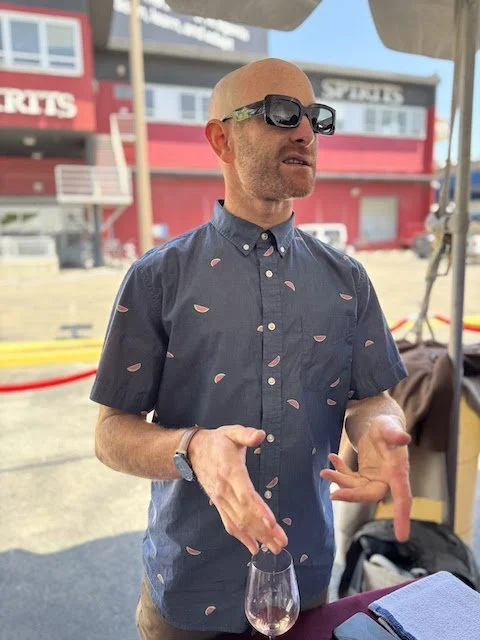
When Ryan Woodhouse, K&L Domestic Wine Buyer, stops a tasting and tells you, “Now this is a winemaker to keep an eye on,” you listen. In this case, he was referring to Samuel Louis Smith, a young winemaker out of the Central Coast. Smith, who was the winemaker at Morgan, has his own eponymous, private label that he started in 2014 as a side project. His portfolio has grown over time but remains tiny by design. SLS focuses on Chardonnay, Gamay Noir, Pinot Noir, and cool-climate Syrah from Santa Barbara, Monterey, and Santa Cruz. After spending two months in Champagne in the summer of 2023 working with Jean-Marc Sélèque and Flavien Nowack, he started making a small amount of sparkling wine. Across all his bottlings he produces about 1,300 cases total. Although very small production, each of them are outstanding.
We fell in love with these wines when we first tasted them half a dozen years ago. Since then we’ve become such groupies that we’ve taken a field trip to visit him in the vineyards and invited him to our first annual Great West Coast Tent Event last year. With new vintages in stock, we’re re-running an interview we did with him from 2019.
On the Trail: When did you decide to become a winemaker?
SLS: Through high school and university, I studied French and Spanish concurrently, discovering early on that I had a knack for languages, and an insatiable lust for travel. I studied Economics as well, and foresaw a career in international business, utilizing all of the above. That all changed during a semester in Bordeaux, which happened to be during the epic 2009 vintage. Visiting Lynch-Bages, living with a French family where food and wine were inseparable, and drinking some pretty legendary wines, specifically a bottle of ’89 Margaux, I saw the light. Still to this day, the art and beauty in haute cuisine and fine wine, and their perfect marriage, is the pinnacle. It’s truly the pinnacle.
OTT: You worked in Australia, Oregon, and Northern Rhône. What brought you back to the Central Coast?
SLS: After working in Australia and Oregon, I returned to Santa Barbara because I believed in the wines. It was also close to friends and family, and there was a promising job at Margerum. After almost three years at Margerum, I got an opportunity to work in the Northern Rhône for François Villard—a dream job! This was 2015. After harvest and some travel in Turkey, Italy, Germany, and Morocco, I was totally broke. Upon my return to California, there was a winemaker job opening at Morgan in the Santa Lucia Highlands. To be honest, I never saw myself in Monterey, but I knew our visions aligned—organic viticulture and cool-climate wines that are complex and quite indicative of their place.
OTT: Are there any memorable moments in your early experience that shaped either your preferred wine style?
SLS: The tour and tasting at Lynch-Bages, and countless hours-long Sunday meals with my Bordelais host family (most notably that which included ’89 Maragaux and roast duck on a cold November afternoon at their countryside farmhouse) set the pace. This is where I learned to drink wine. There, and around the lunch table at Margerum. I learned to make Pinot Noir in the Willamette Valley with Tony Rynders, who makes fairly rich Pinot Noir, and refined my Syrah techniques with François Villard, who makes some of the most complex, aromatic, and lively Syrah. My Pinots tend to be a bit lighter than Tony's, but I think my Syrahs embody a similar profile to François': minimalism in the cellar with an emphasis on aroma and finesse.
OTT: You make three wines from three regions: Sta. Rita Hills, Monterey and Santa Cruz. Can you tell me why you selected each of these regions?
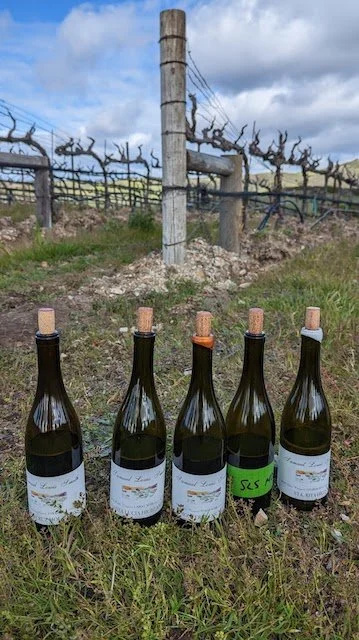
SLS: Initially it was two wines, both from the Sta. Rita Hills. At the time, I lived and made wine in Santa Barbara. Moving to Monterey to make the wines at Morgan made me rethink that focus, inspiring me to explore some other compelling, under-the-radar terroirs where my varietals shine.
OTT: You say “my varietals”—did you always know you wanted to make Pinot Noir, Syrah, and Chardonnay?
SLS: Initially I also really wanted to make Nebbiolo. For me, Piedmont is one of the most stunning viticulture regions in the world, and Barolo is up there with Côte-Rôtie and Volnay for wine drinking preferences. Nebbiolo also does well in cool climates and calcareous soils, much like Pinot Noir. However, in its classic style it takes years and years to open, whereas Pinot Noir and cool-climate Syrah ("Pinot Noir of Syrah") are on a much more approachable timeline—for drinkability and therefore economics. In the foreseeable near future, I can see adding a Northern Rhône white varietal as an counterpoint to Syrah, but that's about it. I'm a perfectionist and a traditionalist. The historic domaines of Europe have been confined to a narrow set of varietals for a given appellation, almost to a fault. But there's a lot to be said about doing just a few things really well. Psychologically, that's where I'm comfortable, so I will build a palace with the support of just a few really strong pillars.
OTT: How do you find your fruit? What are you looking for in a vineyard?
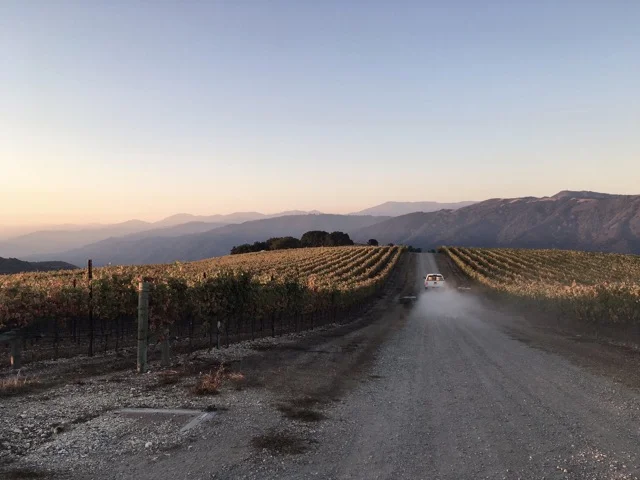
SLS: My criteria is pretty simple: farming practices (ideally organic), proximity to the coast (closer the better), and elevation. The soil for each varietal must also work, and I find myself gravitating toward growers whose visions align with my own, typically favoring smaller scale production with a focus more on quality than on quantity. Low yields are not necessarily synonymous with high quality, but a balanced canopy that focuses more on ripening fruit rather than vegetative growth generally achieves good stem maturity, which is imperative for successful whole-bunch fermentations.
OTT: Do you have a particular style of wine that you prefer to make? The phrase “unmanipulated elegance” keeps popping up in association with your wines. Can you explain?
SLS: If the criteria above are followed, the wine requires little to no manipulation. Often I go out to my vineyards and tell myself, “Wow, this is beautiful. This is perfect. What can I do (or not do) to preserve this experience?” One is inherently moved to only support the fruit’s purity in this situation. That is unmanipulated elegance.
OTT: What do you like most about your wines?
SLS: I consider my wines to be a neoclassical French style. Retaining acidity and balance is very important, but the purity and finesse must be structured. I like how my wines are fairly light on their feet, but do not lack length and depth. These are not “natural wines,” but they are made very naturally.
Explore these elegant California wines from SLS with our current in-stock vintages:
2024 Samuel Louis Smith "Baytree Lane Vineyard" Sonoma Valley Gamay Noir $29.95 97JD
2024 Samuel Louis Smith "Les Granitiers" Monterey County Chardonnay $29.95 98JD
2023 Samuel Louis Smith "Montañita de Oro" Monterey County Pinot Noir $39.95 96JD