
Celebrating 50 Years of K&L
This year, we have the great honor of celebrating K&L’s 50th anniversary! Back on New Year’s Eve 1976, when K&L Liquors opened its doors in Milbrae, it’s hard to imagine that owners Todd Zucker and Clyde Beffa would have had any idea the longevity, not to mention the impact, that their small business has enjoyed. From selling cigarettes and Everclear to becoming one of the preeminent Bordeaux merchants on the West Coast, K&L has been able to stay nimble as times change, while still offering affordable prices and exceptional quality.
We’ve continued to evolve and grow over the years, and 2026 is no exception. With the opening of our New York store marking our first location outside of California, we’re enthusiastically embarking on our next chapter.
In honor of the 50th anniversary, we’re reprinting the story of K&L… one built on friendships, a passion for wine and spirits, and exciting business innovations.
K&L History: A Tale of Friendship and Fair Pricing
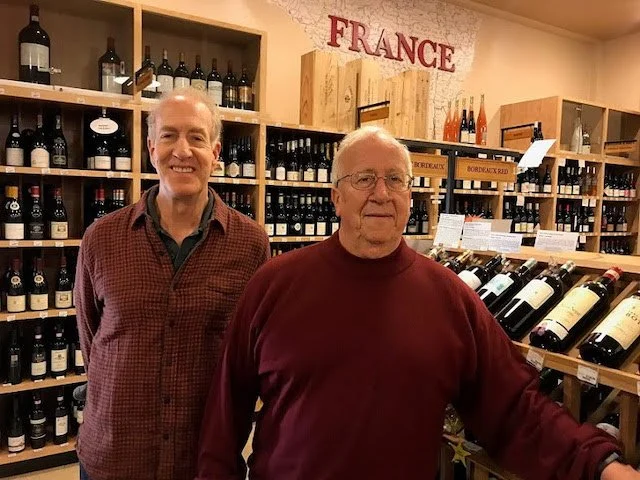
What’s the trick for long-lasting friendship? If you are Clyde Beffa and Todd Zucker, founders of K&L, the trick seems to be going into business together. Todd and Clyde met in 1947 when they lived across the street from one another in San Mateo. Legend has it that some sand was flung at their first meeting (they were two), but they nonetheless became thick as thieves. And, after nearly 50 years in business together, they remain so to this day.
That seems an amazing feat, and, turns out, there’s an amazing story behind it! Clyde and Todd graciously told us the history of K&L, with all its twists and turns and intrigue. It’s not quite as saucy as rum runners and speakeasies, but there was a bit of fighting the law, and it did all start with a Playboy...
The Booze Bombers
Though Clyde and Todd went to different schools when they were kids, they remained close and even lived together during their college years for a time. They remained friends as each began to follow his own career path in the late 60s. Clyde went into his family business and started a dairy ranch in Tracy, while Todd went into insurance. Eventually some friends convinced Todd to get into the liquor biz, and they started Parkside Liquors in San Francisco. But little did Todd know that it was a uniquely transitional time in the industry, and that he’d find himself right at the turning point.
Back in those days, there were stricter laws governing the sale of alcohol. Wholesalers had to publish prices, and retailers were required to sell at those prices or higher. It was likely a throwback to post-Prohibition regulations, but it wasn’t popular with retailers who wanted to offer competitive pricing, and there were some who fought the system—including Parkside. According to Todd, “Retailers decided to challenge the law, knowing that what we risked were fines and the potential revocation of our license. My partners and I were challenging the law by undercutting the posted prices. There were several dozen retailers that were visibly doing so, and some that were more discreet.” Called “bombing the price,” this practice was an attempt to make their businesses more competitive. The bombing business was booming.
So was Clyde’s, “just milking cows” as he says, and, in 1971, he and Kay (“K” of K&L; Todd’s wife Linda is the “L”) got married. But, while on an airplane to their honeymoon, Clyde read a Playboy article on wine collecting that would change his life forever. (He chuckles at the fact that his wife was reading the more honeymoon-relevant Love Story.) Clyde: “Collecting wine was the rage in the United States at that time. Before that everyone drank spirits and cocktails. It looked like fun. I got bitten by the bug.” In 1973 he sold the dairy and moved to San Mateo. He was semi-retired and 28 years old. And here’s where he got “crazy into wine: I had a cellar. I’d go over to Wente and Concannon for tasting, and I joined tasting groups. In the meantime, I was buying from Todd because he had good prices.”
In October of 1976, Todd and his former partners decided to go their separate ways, so Todd went to Clyde and said, “Let’s do this together.” But first, Todd went to see an attorney named Don Tenenbaum. According to Todd, “He felt there was a good defense challenging the constitutionality of the laws as written in California. He thought we had a strong case, despite the risks. Clyde and I decided to run the risk.” Clyde: “We teamed up with another retail liquor guy, selling out of our house. We delivered it directly to the customers. In November of 1976 we found a place called Ernie’s Liquor Store, but the owner didn’t want to sell before Christmas, so we opened on New Year’s Eve. It was a small crew. It went from there. We were bombers there too.” Todd says, “Right away we were in the doghouse with the ABC (Alcohol Beverage Control).”
In June of 1978, the whole game changed. Clyde and Todd were up to go to court to lose their license, but their attorney represented a bomber case just before theirs that would change history. The judge ruled in favor of the bombers, saying the law was against the Commerce Clause of the Constitution. The case then climbed the legal ladder to a State Appeals Board, the State Supreme Court, and finally all the way to the U.S. Supreme Court. After several years in the system, the law was officially struck down in California, and all the accusations were cleared. Retailers were now free to set their own prices and pass savings onto their customers. That opened a new chapter for alcohol sales in California, and for K&L. Todd says, “We took a calculated risk. It’s an interesting story, but we were not great crusaders. We were just at a turning point.”
Developing the K&L Niche
In August of 1978, Clyde and Todd opened the Redwood City store, which is still one of the five stores operating today. Thus began the next chapter of K&L, though it was also a canny connection to the past, as the space had been used as a bomber back in the old days. When they opened Redwood City, wine became the front-and-center driver of K&L. Clyde says, “Parkside had been selling Carlo Rossi or Gallo—jug wines—and was 90 percent liquor. So really we slowly changed the business.” In fact, there was a moment when they almost stopped selling liquor entirely. But they ended up hiring some talented people over the years—Susan Purnell, David Driscoll, and David Othenin-Girard—who have helped make it a strong category, and usher K&L into this current era of cocktail and spirits enthusiasm.
Once prices had been deregulated, big box retailers started to get into selling discount booze. Safeway started Liquor Barn, then Price Club followed suit. So Clyde and Todd had to get smart to stay in business. Clyde says, “They could buy a thousand cases so they could undercut us. We couldn’t go head to head with them, so that’s how we got into high end. We got more and more specialized. Started going to Europe in 1982, then 1985 to Bordeaux all the time. The big turning point was when we started importing wines directly from small winemakers in France. Then we could compete with Liquor Barn.”
The ability to build direct relationships with producers and bring in wines by way of friendly importers made K&L more competitive with other wine retailers. Perhaps more importantly, it also gave us a personal connection to the wonderfully talented winemakers that we champion. We can offer wines from producers we really believe in, who often fall under the radar in the U.S. Clyde says, “This part of the business enabled us to offer better prices and unique bottles. In the 90s, we expanded the business into other regional wines, which complicated things.” Clyde and Todd realized they needed more expert help, so they brought in specialists. Joseph Zugelder was the first, in 1991. He was interested in collections and buying cellars. In 1997 they brought in Greg St. Clair, who was our stellar Italian buyer until he recently retired. “I was not interested in Italian wines, and he really made that market take off. Gary Westby came in 2000 as our Champagne buyer. We got more and more specialized with more buyers.”
Making our own Kalinda label was another way that K&L could offer low prices and compete with the big corporate giants. The idea was sparked during a conversation between Clyde and winemaker Bob Pellegrini: “I was talking to Bob Pellegrini one day in the early 80s, and he said ‘Why don’t you have your own label? Then you can compete.’ Kendall-Jackson was just coming out. So I said OK, and we went to taste and blend with Pellegrini. We stuck with it.” Today we still carry Kalinda wines, as well as a robust private label program: the Discovery Series, Anonymous Wine Collective, K&L Liquors, and our newest from the Rhône Valley, Rendez-Vous.
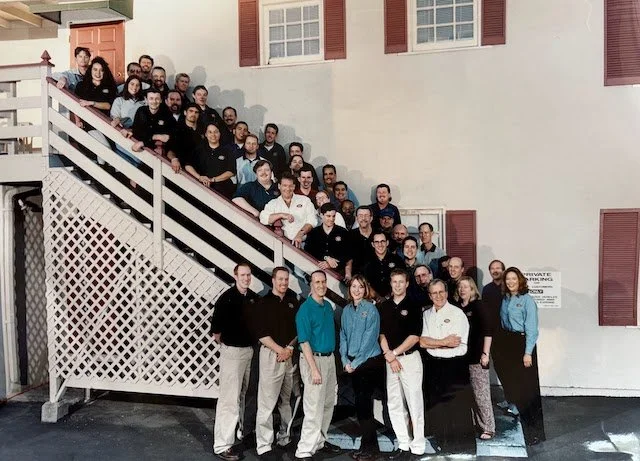
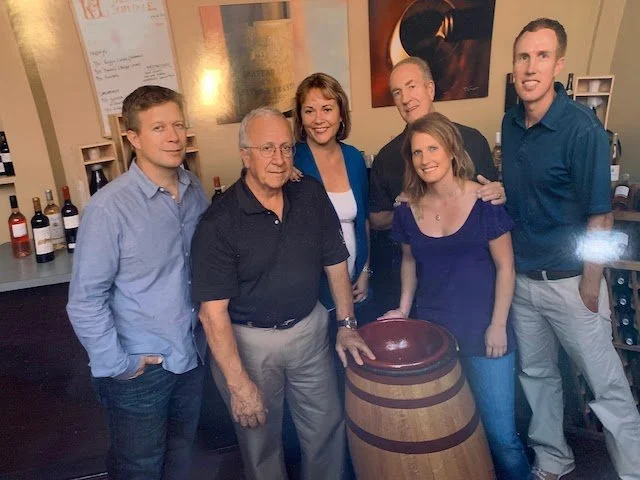
When the next generation, Clyde and Todd’s children, came on board, they brought a whole new set of skills and enthusiasms. “We were one of the first ones to get on the internet—March of 1997. Brian (Zucker) focused on developing software and new computer systems, and Trey (Beffa) honed his skills as a wine buyer. We were one of the first to have a website. We got mentioned in Wine Spectator, Wall Street Journal, Money Magazine, etc.” Today, online sales constitute a very high percentage of K&L’s business. Their daughters, Kerri (Beffa) and Molly (Zucker), were also major factors in the business’s success, with Kerri overseeing events and Molly launching the auction department. Today, there are grandchildren in the mix (though not yet in the business), and nearly 200 employees across five locations. It’s a family company that’s grown in scope and scale over the last five decades, but has held onto what it was founded on—friendship and a passion for wine.
- Kate Soto, Digital Content Specialist