
Look to Spain's Galicia Region for Exciting White Wines
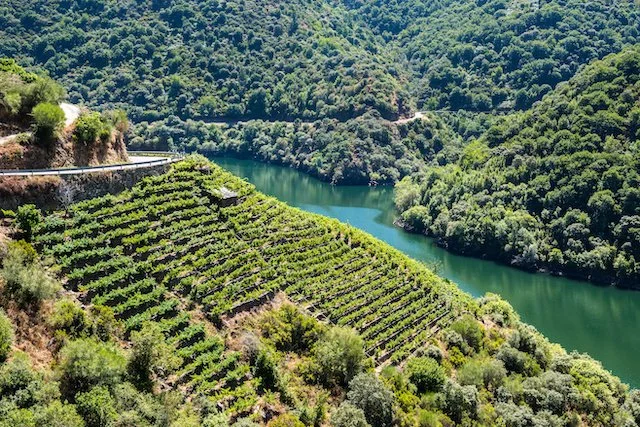
Galicia is a region apart from the rest of Spain. In a country that is best known for its red wines, this is a region that predominantly makes white wines. It is green and wet in the summer rather than brown and pushing 100 degrees. Located in the northwest corner of the peninsula, it is culturally different from the rest of Spain. The local dialect is Gallego, which is a hybrid of Castilian Spanish and Portuguese. When looking at a map of the peninsula Galicia and northern Portugal stand out. The Vinho Verde wine region is located just south of the border between Spain and Portual. There and in Galicia viticulture is similar. Most land holdings are small family plots, and they train their vines almost two meters above the ground in order to use the land beneath the vines to grow other crops. They also share many of the same varietals, the classic Vinho Verde varietals are starting to play more importance in Galicia, and likewise Albariño is becoming more important in Portugal. That brings me back to the most important wine region in Galicia, Rias Baixas. What is interesting is that it is better known for Albariño than even by its own name. I am as guilty as the next person for this, as I rarely ask someone if they like the wines from Rias Baixas; rather I ask if they like Albariño. I think that Albariño is one of the most exciting white grape varieties in the world. Here is a selection of some delicious Albariños currently on our shelves, all comfortably under $30. These are definitely worth checking out for any white wine drinker!
2023 Bodegas Albamar Albariño Rias Baixas $25.99 This is salty, fresh with great aromatics. This is a classic Albariño from the Salnes Valley from a producer who has been elevating the possibilities of the variety. He is working organically and sustainably in a region where it is more than just a challenge to do so. His efforts in the vineyards are matched in the winery. Whole-cluster fermentation with native yeast, shorter aging in a mixture of large neutral barrels and stainless tanks, and, importantly, he suppresses malolactic fermentation. These wines are pure and elegant. They have great focus; the crisp acid pulls the pure fruit across the palate and all the while the flavors seem to build and build. This is an incredible expression of the varietal.
2021 Lagar de Costa "Calabobos" Albariño Rias Baixas $27.99 Here is a wine that is made in a fashion that focuses and accentuates the marine quality of the Salnes Valley. Calabobos is the local name for the light drizzling rain that the region is famous for. It is a perfect name for me because one of my favorite ways of explaining minerality is with the concept of petrichor—that earthy, stony aroma of rain, or, as I like to put it, the smell of wet rocks. This is an old vine Albariño that was sourced from two small vineyards that are just meters away from the sea. It was fermented in tank then aged for about a year in a concrete egg. This is marine wine—the minerality that shows up on the finish of this wine has a salty sea air like quality to it. Intense, long, and mouthwatering, here is a wine for everyone who loves to talk about minerality. I love it.
2023 Lagar de Fornelos "Pazo de Seoane" Blanco Rías Baixas $21.99 This is a winery that is located in one of the lesser-known subregions of Rias Baixas, the O Rosal. This is the southernmost corner of the region; it is located on the coast and along the Miño River. It is literally a stone's throw from Vinho Verde in Portugal. This is a slightly warmer region than the better known Salnes Valley. Here it is typical to find some other varietals blended in with Albariño. With this wine there is Loureiro, Caiño Blanco, and Treixadura. For simplicity’s sake these bring more body and more aromatics to the wine. The winemaking here is simple, stainless fermentation, it does not undergo malolactic fermentation, and it is aged for several months on lees. The core of this wine is Albariño, it has the classic acid and minerality, but the nose and body are more dynamic, as if Vermentino or Viognier were added. It makes for a very inviting wine and presents more pairing opportunities.
2023 Eduardo Peña "Castrelo de Miño" Ribeiro $24.99 Taking the long way from O Rosal up the Miño river will take you to the region Ribeiro. We are now away from the coast and into the granite hills framing the river. This is the crossroads of Galicia. What I love about this is that this is the region that is the most “Gallego” of the appellation. What makes this the most Gallego region are the percentages of varieties that are planted here. There is Albariño but there is more Treixadura planted. Loureiro is common, so is Godello, and, in true Spanish fashion, there are varieties here that are not planted anywhere else. With a little over a decade of experience Eduardo Peña has made a big reputation for himself. The soil here is different than the more coastal appellations. Here schist is as common as the granitic sands; for me it brings a slightly different energy and minerality—more lingering stony than the almost salty coastal minerality. The wine is made with native yeasts, malolactic fermentation is suppressed, and then the wine is aged in neutral barrels of European origin. The neutral oak and the blend of grapes give this wine an exotic nose—there are layers of fruit, spice, herbs, and flowers that have no equivalent with the rest of Galicia nor Spain. The palate takes those exotic aromas and wraps them around the sleek and textured palate. It has moderate weight and mouthwatering acid and tremendous depth. It is hard to do justice to this wine in words.