
The Krug Ambassade Voyage
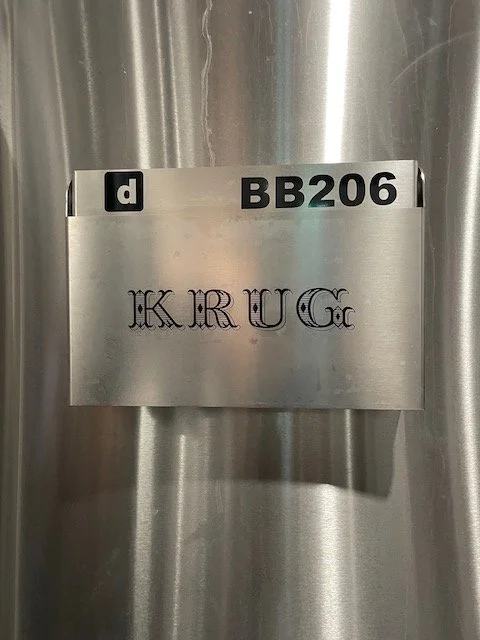
It was a great honor to be invited by Krug this July on their Ambassade Voyage. Spending time with other Krug lovers from the industry—mostly Michelin Star chefs—and learning about Krug was a highlight of my career. It is the second time I have had the opportunity to travel with this group, but the first time that the destination was Krug’s own facilities in Champagne. My mind is still blown—it was the experience of a lifetime.
Not only did we preview yet-to-be-released 2008 Krug "Clos d'Ambonnay" Brut Blanc de Noirs Champagne in the Clos d’Ambonnay, the 2009 Krug "Clos du Mesnil" Brut Blanc de Blancs Champagne in the Clos du Mesnil, and the Krug "Grande Cuvée" 173ème Édition Brut Champagne at the Krug House in Reims, but we tasted countless older bottles, 2024 vin clair, and learned so much from the winemaking and vineyard management team as well as from Olivier Krug himself.
The whole time we were there, Champagne was having an unprecedented heat wave, and the mercury went as high as 107 degrees. It will be another August harvest in the region, the new normal, but I am pleased to report that since I left, the region has cooled down and even got a bit of refreshing rain. Luckily, there was no shortage of Krug for thirsty ambassadors!
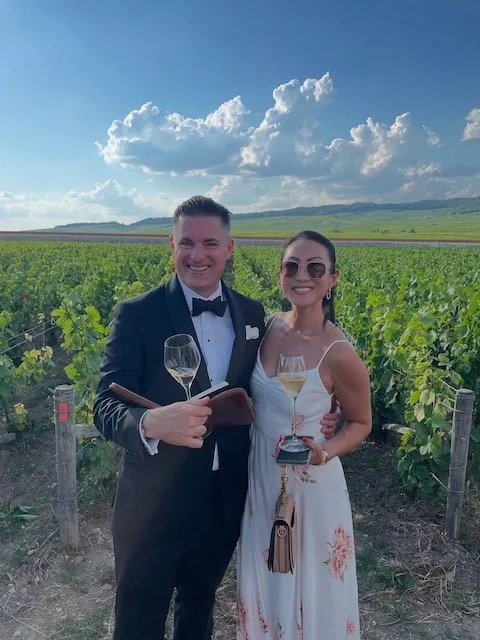
Gary and Krug USA director Estelle Ngo in the Clos d’Ambonnay
We started the event off with a black-tie event at the Clos d’Ambonnay, and I can report that this site is very, very well exposed to the sun. It was a little hot in my wool tuxedo for the aperitif in the vineyard, but the Krug "Grande Cuvée" 172ème Édition Brut Champagne (Krug ID 123006) that poured freely made it more than tolerable in the heat. We were there to see the “Joseph” winemaking facility there, a brand new set of buildings that were just opened in 2024 adjacent to the Clos, and to have our Gala Dinner, cooked by none other than three-star Michelin chef and fellow Krug Ambassador Arnauld Lallement from L’Assiette Champenoise. The 172nd Grande Cuvée tasted like it was almost sold out, with generous limey drive and refreshment, deep chalky minerality, layers of complexity and fabulous texture. Even when my glass warmed up, this incredible Champagne was still refreshing.
The last time I visited the Clos was in 2007, for the debut of the first vintage of Clos d’Ambonnay, the 1995. Back then they only had a tiny winemaking facility here, just big enough to vinify the 1.68 acres of Pinot Noir in the Clos. Starting with the 2024 harvest, all Krug will be made here, save the Clos du Mesnil. It is a rule in Champagne that any “Clos” designate wine must be made adjacent to the vineyard. The new Joseph facility is a spectacular space, kitted out for maximum efficiency, with only two layers of barrels and double decker tanks that are easy for the team to access. It is one of the first things one sees when driving into Ambonnay from Bouzy on the left-hand side, just across the little square from Benoir Marguet’s place.
While visiting the winemaking facility, we were treated to a preview glass of the almost incomprehensibly great 2008 Krug "Clos d'Ambonnay" Brut Blanc de Noirs Champagne (no Krug ID yet). They wouldn’t say when this is going to be released, but it should be within a year or two. This light golden Champagne had a nose of exotic nuts, but the expected toast of 17 years of aging was nowhere to be found—the leesy character is taking a back seat to the incredible power of the old-vine Pinot Noir from this legendary vintage right now. I wrote that it had “palate-staining chalk and black-cherry savor that plumbs the depths” as I searched for words to describe this masterpiece. How can something with so much vinous complexity and awesome power be so refreshing and bright? The finish was dazzling—a near psychedelic display of flavors and incredible length.
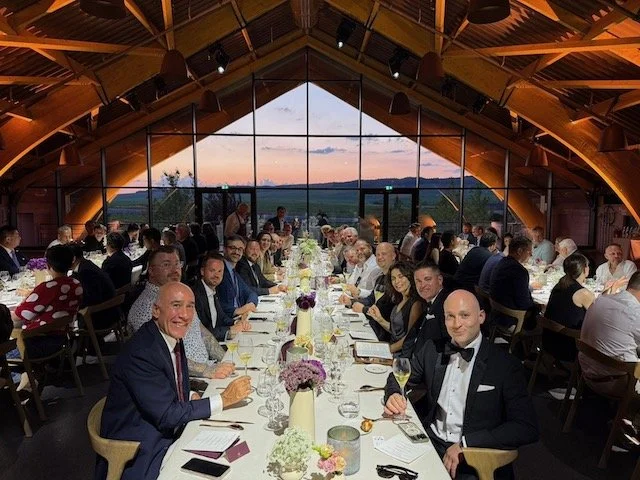
Seated where 1000s of barrels usually rest.
After the rest of the tour, we sat down for dinner—in a room that is usually filled with half of the 4300 casks they need at Krug to ferment the harvest each year. Julie Cavil, cellarmaster at Krug, told us that this will be the first and last dinner at the Clos d’Ambonnay. She is never going to move those 2150 barrels back and forth again! It is too bad, as the sunset was spectacular looking north up the vineyard and towards the forest of the Montagne de Reims.
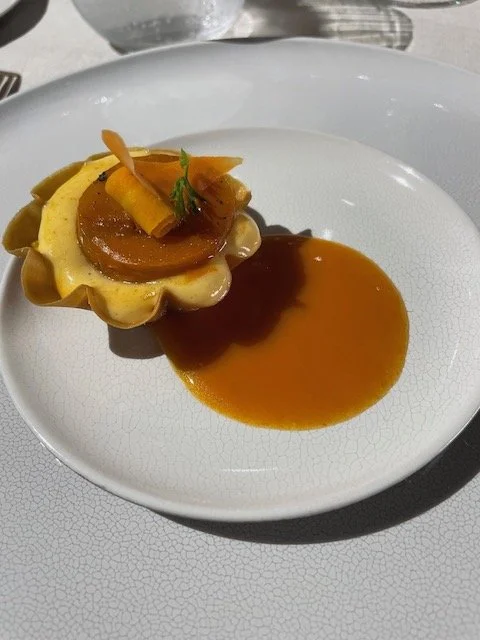
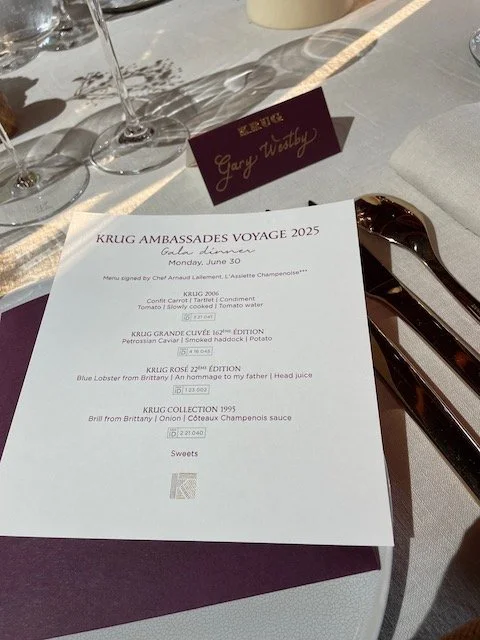
After I found my place setting, we started with 2006 Krug Brut Champagne (Krug ID 321047) paired with an incredible tartlet of confit carrot. This vintage is what I call “old-school hot”—at the time it was considered a very warm year, but now, after 2015, 18, 20, 22 and 23, it seems cool by comparison. At 19 years old, the wine had a gorgeous golden color and was absolutely loaded with decadent brioche on the nose. In the mouth it had a lot of balancing bright citric quality, and the finish was rich and full. The pairing was a big success, with sweetness of the carrot bringing out the higher tones in the wine.
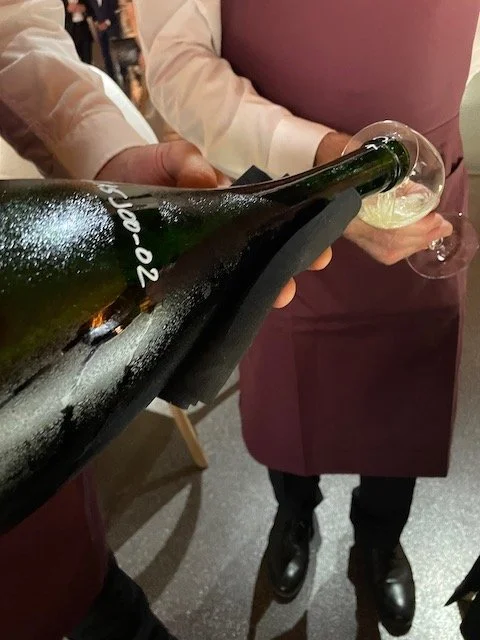
Unlabeled Krug Grande Cuvée 162nd edition in Jeroboam
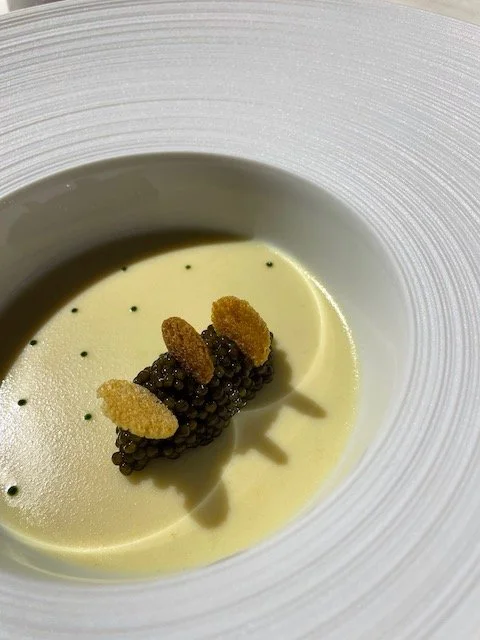
My wine of the night, in fact my wine of the whole trip, came next, paired with Petrossian caviar. It was the Krug "Grande Cuvée" 162 Ème Édition Champagne Jeroboam (Krug ID 416045) and I must say that the three-liter format suited this wine perfectly. This “shiner” (no label) Jeroboam had been disgorged for 9 years, but never left Champagne. With 11 vintages inside, as old as 1990 and as young as 2006, it was peak Krug. It had a beautiful light gold color, and an explosive bouquet of beurre d’Issigny, white truffles, and blood orange. In the mouth it not only had concentration, but also grace notes, and the caviar brought out the nuttiness in the top-quality Pinot Noir in the blend. The texture was perfect, creamy, with a lazy bead, and the finish was unforgettable, with a clean line of limey acidity and a dazzling peacocks display on the finish. Unforgettable wine—unforgettable pairing.
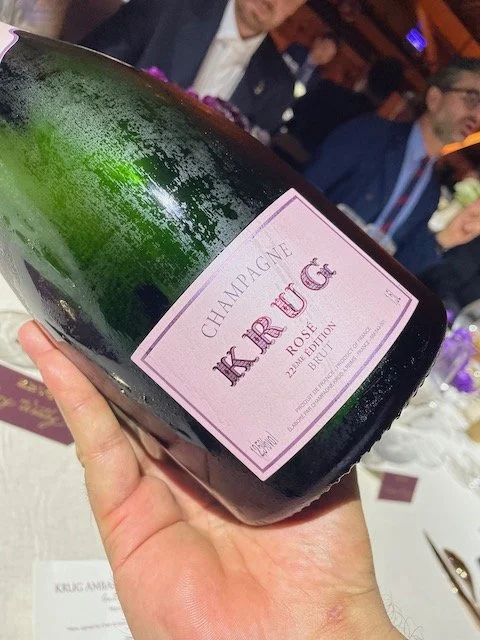
With Arnaud Lallement’s signature dish, the Blue Lobster, we had the Krug Brut Rosé 22 Ème Édition Champagne from magnum (Krug ID123002), just disgorged the winter 2022/2023 and spanning all the vintages between 2005-2010. This wine had a color between copper and light strawberry, and a beautiful bouquet of delicate, subtly savory maraschino cherry. In the mouth it had a wonderful blood orange twist, and a bit of nice amaro like bitterness that countered the sweetness of the lobster perfectly. It was one of my favorite Krug Rosé’s that I have tried.
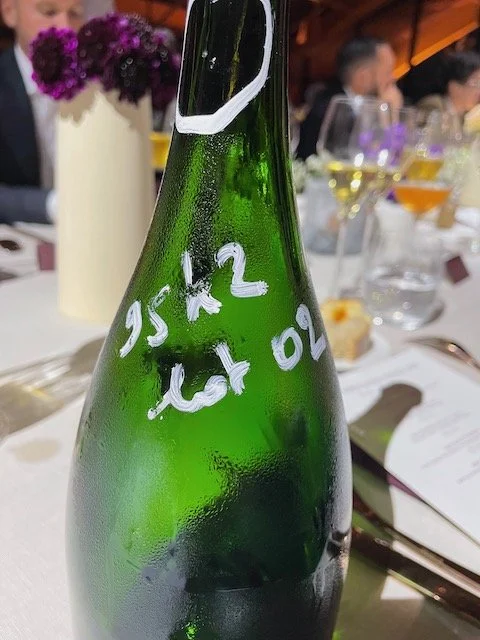
1995 Collection, unlabeled and delicious.
We wrapped up the night with Brill fillet from Brittany, paired with the 1995 Krug "Collection" Brut Champagne (Krug ID 221040), one of the most decadent, rich bottles of Champagne that I have ever had. At 30 years old, this is a true brioche bomb, with fantastic complexity and great savory porcini and black truffle layers. The real kicker is that for all this incredible opulence. It stayed refreshing, easy to drink, and moreish. Collection is Krug’s late release program; this bottle was not disgorged until spring of 2021. We just received a few bottles that came straight from Krug this year—and unlike the one we drank, they have labels!
The next day, we headed south to the hallowed ground of Mesnil Grand Cru, and to the Krug Clos du Mesnil to learn about the production there from Isabelle Bui, their winemaking development manager. This 4.5 acre plot in the mid-slope of the village has been making single-vineyard Blanc de Blancs for Krug since the 1979 vintage. Although the team could pick this small vineyard in a half day, they choose instead to pick very selectively, usually over four days. The production here varies wildly—and they don’t always make a Clos du Mesnil bottling, sometimes saving the entire production of the vineyard for Grande Cuvée. When it is made, they make between 9000 and 14,000 bottles. Again, I can attest to the great exposure here—it was getting plenty of sunlight on this, the hottest day in the history of Champagne!
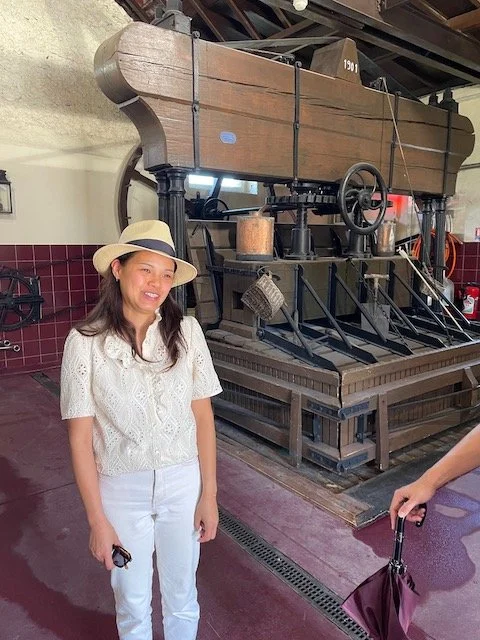
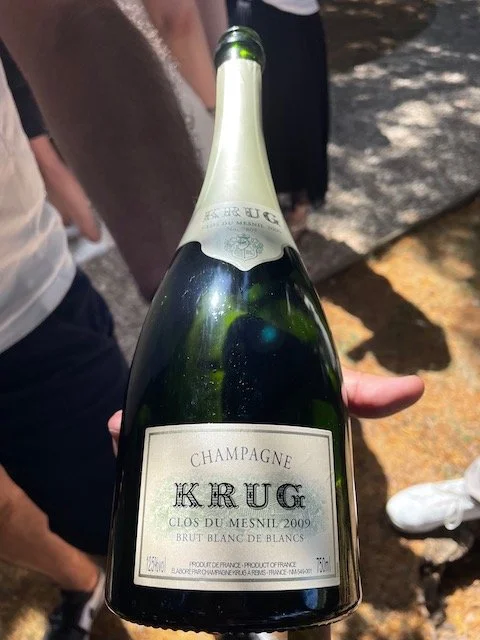
We tasted a preview bottle of the 2009 Krug "Clos du Mesnil" Brut Blanc de Blancs Champagne in the vineyard, and I found it to be young at 16 years, but far more open than the monumental 2008. I loved the ripe citrus and subtle brioche of the bouquet, and the great silky texture of this single-vineyard masterpiece. The finish had fine butter, round stone fruit, and incredible minerality from the bright white, Belmnita chalk of this top site. We hope to get some by the end of the year.
We then went to taste some of the 2024 vin clair with Julie Cavil, the chef de cave, and I was lucky enough to get seated next to her for the tasting. She picked a great representation of the region: two Chardonnays, Mesnil and Villers Marmery; two Pinot Noirs, Ambonnay and Les Riceys; two Meuniers, St. Gheme and Ville-Dommange; finishing off with reserves of 2012 Verzenay and 2008 Avize. I tasted hundreds of 2024s on my spring trip to the region, and it was clear that there is a gigantic difference at Krug. The wines were much higher in acidity and clearly chosen and vinified for long term aging. I even noted the 17-year-old Avize Chardonnay as “still SUPER YOUNG.” In 25 years of doing this job, and after dozens of visits to Krug, this was my first time tasting the base wines… It was worth the wait.
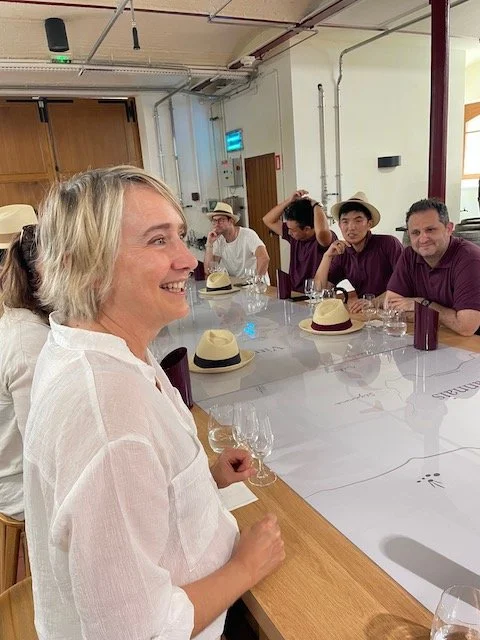
Chef de Cave Julie Cavil leads the still wine tasting.
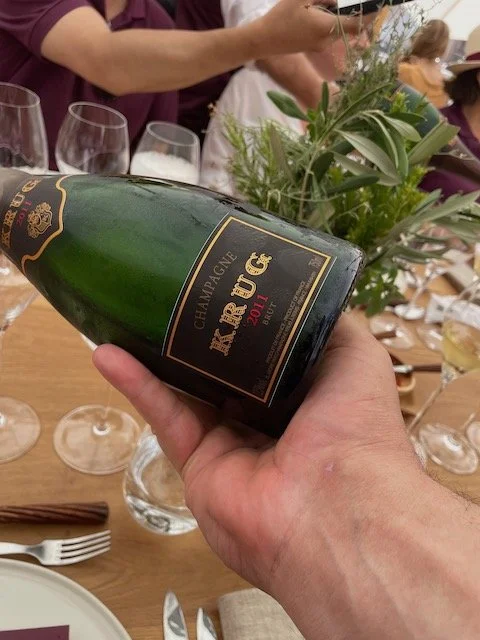
We then sat down for an alfresco lunch in the Clos, starting off with the exceptional 2011 Krug Brut Champagne (ID 422050). This vintage is tragically underrated, and in fact has a lot of the features that we miss in the modern world of hot vintage after hot vintage—the best of which is a ton of freshness. The roles of the different grape varieties were flipped this year—Julie explained that the Meunier provided the acidity and the Chardonnay the maturity in this wine. This was a very small run in the context of Krug vintage offerings, and the selection that they made is going to make this the surprise of many a blind tasting. I think it would be quite easy to mistake for a 2008, with not only great Puligny-like lime focus but also definitive minerality on the super long back end.
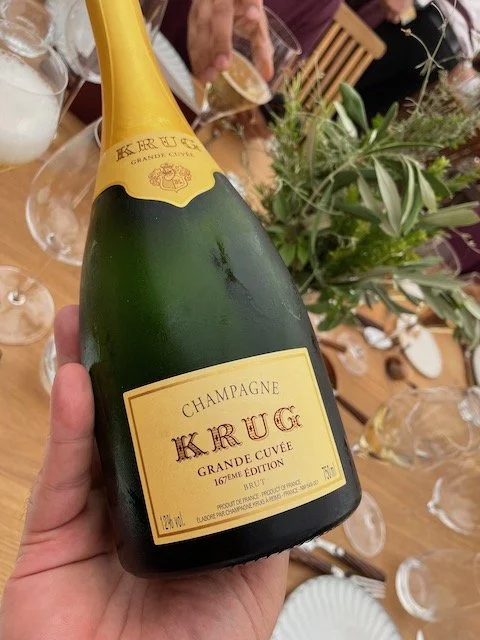
Next to it, we tasted the Krug "Grande Cuvée" 167ème Édition Brut Champagne (ID 419039), containing 13 vintages, the youngest of which is 2011, and the oldest 1995. This surprised me, as it had a lighter color than the 2011—perhaps because less-ripe parcels were selected for the Grande Cuvée. I must admit that aged Grande Cuvée is one of my favorite wines on the planet, and the combination of youthful brightness and encyclopedia-like complexity in this bottle knocked me out. It was too bad that it was at lunch on a 107-degree day… I will regret not drinking more of this (especially with the excellent sea bass and octopus) for the rest of my life!
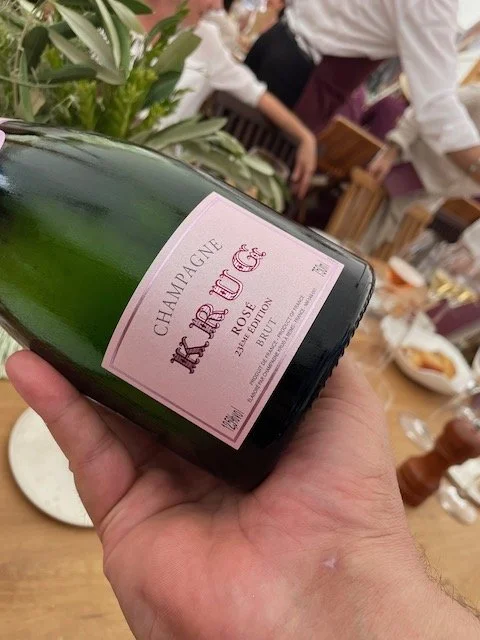
We finished off the lunch with the Krug 23 Ème Édition Brut Rosé Champagne (ID 415063) which was as intense as rosé Champagne comes. This also starts on harvest 2011, with 10 vintages going back to 2000 inside. They usually use Aÿ Grand Cru for the red wine in their rosé, and that was the case with this one. Sometimes, Bouzy and even Mutigny are also sources of the red wine in Krug Rosé. This had a coppery orange color and super intense red cherry fruit married to a pain au levin toast. It went exceptionally well with the Cour d’Armoise chicken in a Jura wine sauce.
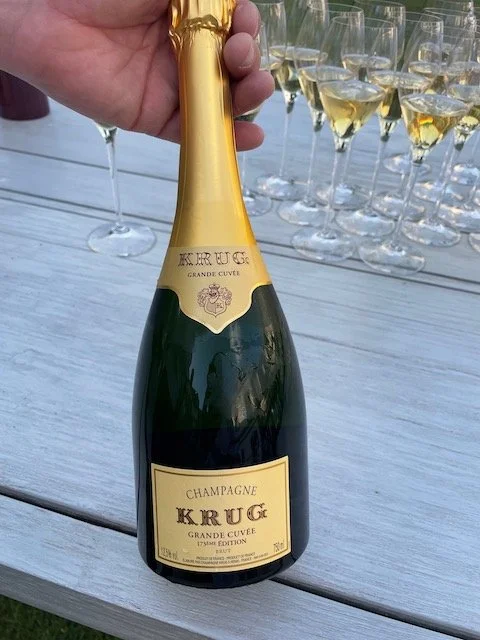
After a couple of hours to freshen up at the hotel, we headed to the Krug House in Reims, the original residence of the family, immediately adjacent to the old winery. Now the Reims winery will be used for overflow, and, of course, for storing bottles, of which there are still hundreds of thousands in the caves underneath the maison. Before descending into the cool of the caves, we were welcomed in the courtyard with a taste of the not-even-out-yet Krug "Grande Cuvée" 173 ème Édition Brut Champagne (ID 124002). We will be looking forward to seeing this 13-harvest blend that spans 2001 to 2017 at the end of the year. This edition immediately reminded me of one of my favorites when it was young—the 160th, with the youngest element being 2004. With a white gold color, this wine has a fantastic bouquet of drawn butter, black truffle, and Pulingy-Montrachet like lime. The combination of richness and lively acidity, decadence, and chalk have me looking forward to the end of the year!
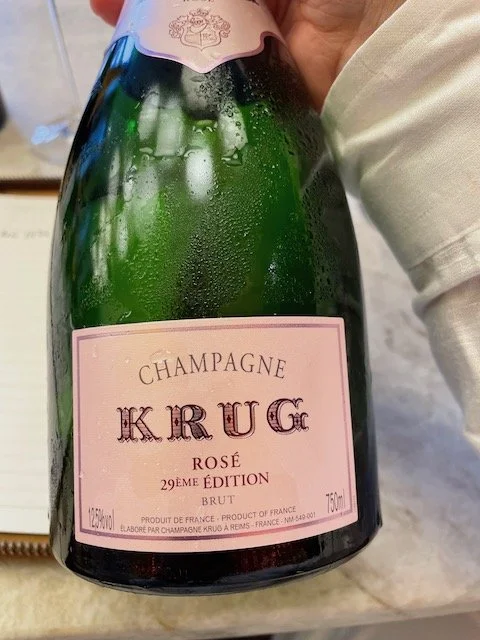
We also tasted the Krug 23 Ème Édition Brut Rosé Champagne (ID 124021), which, like the Grande Cuvée above, will arrive at the end of the year. This pale pink beauty had a lovely nose of subtle strawberry and fresh baguette, but in the mouth the fruit opened and the incredible chalky depth that these wines are known for was revealed. Like the 23rd edition at lunch, this had red wine from Aÿ for the color and flavor. It is a combination of five vintages, as young as 2017 and as old as 2010, and although it is only 28% Chardonnay, it tasted like it had a lot more, given the drive and brightness of the wine. The finish was long and deeply mineral—what a success!
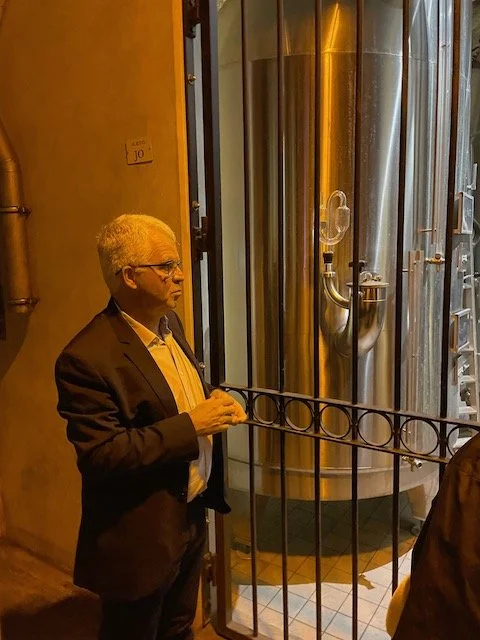
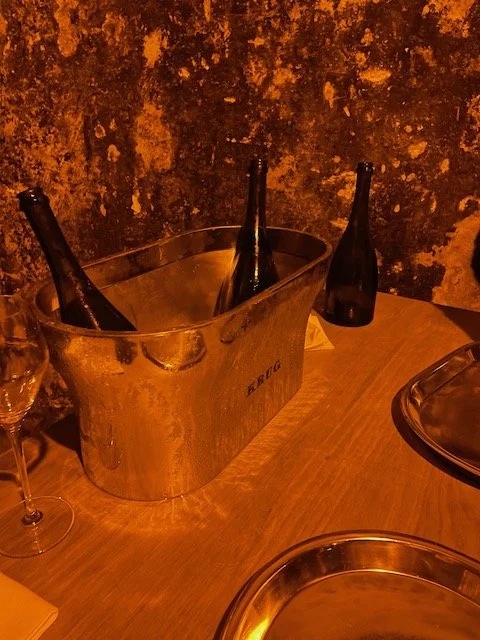
Going into the Krug caves with Olivier Krug is always a treat… He has the keys to a lot of cool stuff down there! After walking down lots of stairs to the deep part of the cellar, we arrived at the wine library. After looking at the incredible collection of reserves in tank here, and the mind-boggling collection of old vintages in bottles and magnums, he poured us the 1982 Krug Collection. This was extra exciting, as it is the birth year of my fellow Krug Ambassade Mark Bright, wine director at Saison—what a treat to get to taste this! This wild wine was full of life and vigor after 43 years and shows why Krug is the gold standard for age-worthiness in Champagne. With a combination of buttery brioche, crazy fresh white truffle on the nose, and a cascade of vibrant, emerald limes and incisive chalk on the finish, this was spectacular. The finale went on and on… I can still taste it now!
We wrapped up the event with an incredible “Krug Food Court” in the area where they usually wash the barrels. Cooks from all over France prepared small plates of everything from oysters to charcuterie, and we mingled and enjoyed. The last thing in my glass was 2002 Krug Vintage from Jeroboam… What decadence! The savory, buttery, pastry-filled nose of this top-notch vintage gave way to a full bodied, creamy palate and a crisp, citric finish.
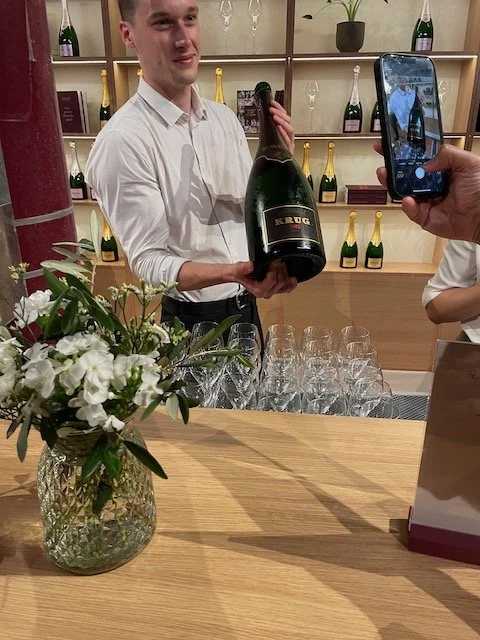
This unforgettable trip was a great reminder of just how high in the pantheon of great wines the house of Krug is. They are simply among the best in the world, regardless of style. Thank you, team Krug, for the invitation!
A toast to you!
- Gary Westby, K&L Champagne Buyer