
Elegant In-Stock Cabernet Franc from the Loire Valley
When people think of Cabernet Franc, they often default to Bordeaux or New World versions—ripe, plush, sometimes oaked... sometimes too much oak. But my favorite expressions come from the Loire Valley, where Cab Franc sheds the excess and takes on something more honest: earthy, floral, fresh-fruited, savory, and deeply connected to place.
Across the Loire, especially in Chinon, Bourgueil, Saumur, and Anjou, Cabernet Franc isn’t just shaped by the region’s cool climate—it’s the soil that really defines the style. Each appellation brings its own personality to the table. In Saumur and Chinon, Turonian limestone is the foundation. If you could cut a cross-section through the region, you’d see miles of ancient tunnels carved into the soft stone, used historically for wine cellars and mushroom farms. Saumur sits mostly on limestone, with lighter clays and sands layered on top. Chinon, shaped by the flow of the Vienne River, has more alluvial soils over its limestone base, lending nuance and variation depending on vineyard site.
Saumur wines tend to show more structure and backbone—some of the sturdiest in the region—while Chinon, depending on where you're standing, can swing from firm and savory to lighter and more aromatic, especially in those gravelly, river-adjacent parcels. Bourgueil often lands somewhere in between, leaning savory but with a little more rustic grip. Over in Anjou, the mix of schist and basalt soils gives you wines that feel a little more plush and juicy—less angular, more rounded—though they still carry that signature Loire freshness.
Whichever pocket of the region you explore, there’s a lot of range here. From bright, peppery reds you can throw a chill on, to more serious bottles that deserve a few years in the cellar, Cab Franc from the Loire keeps things interesting. And if you’re just getting started, the fun is in figuring out which expression speaks to you. There’s no shortage of personality here—it’s just as much about the rocks as it is the grape. And for those of you who know me, know I love my rocks!
Some of my top picks on the shelves right now:
Joël Taluau Is St-Nicolas-de-Bourgueil’s Best Kept Secret
We’ve been working with the wines of Taluau-Foltzenlogel for many years now, and they continue to be one of the most consistent and compelling values on our shelves. Based in the small hamlet of St-Nicolas-de-Bourgueil, the domaine focuses exclusively on Cabernet Franc, crafting wines that are honest, expressive, and incredibly well-priced.
The 2023 Joël Taluau "Expression" St-Nicolas-de-Bourgueil $12.99 is exactly what the name suggests—a pure, vibrant take on Cab Franc. It shows off notes of lavender, wild thyme, cherry, strawberry, and rosehip, with a smooth, supple texture that makes it dangerously easy to drink. It’s a perfect candidate for a light chill and shines on weeknights next to something simple like rotisserie chicken.
If you're looking for a step up, the 2022 Joël Taluau St-Nicolas-de-Bourgueil Vieilles Vignes $16.99 brings more depth and structure without losing that drink-now charm. The old-vine fruit adds richness and complexity—black currant, sage, tapenade—with a frame that can handle braised pork or seared duck breast. Add in some herb-roasted potatoes and sautéed greens, and you're in business.
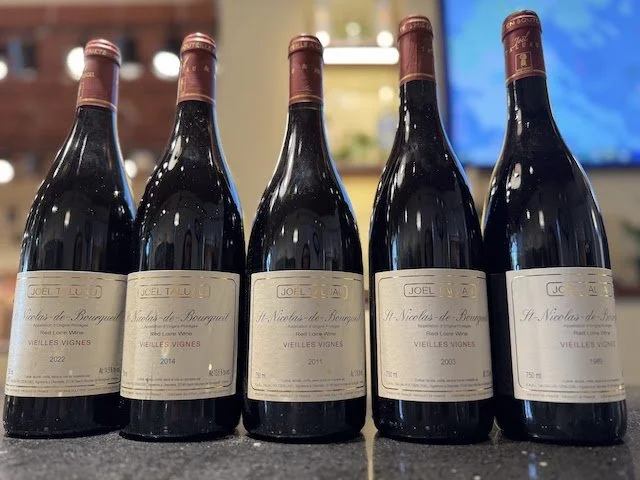
But where things really get exciting with Taluau is in the library releases. Every year, we receive a small, handpicked allotment straight from the domaine’s cellar. Availability changes depending on what’s showing well, and this year’s haul is one of the best in recent memory: 2014, 2011, 2003, 1997, and the legendary 1989 vintage are all on offer.
2014 Joël Taluau St-Nicolas-de-Bourgueil Vieilles Vignes $29.99 and 2011 Joël Taluau St-Nicolas-de-Bourgueil Vieilles Vignes $29.99 still have plenty of youthful energy, with bright fruit and fresh acidity.
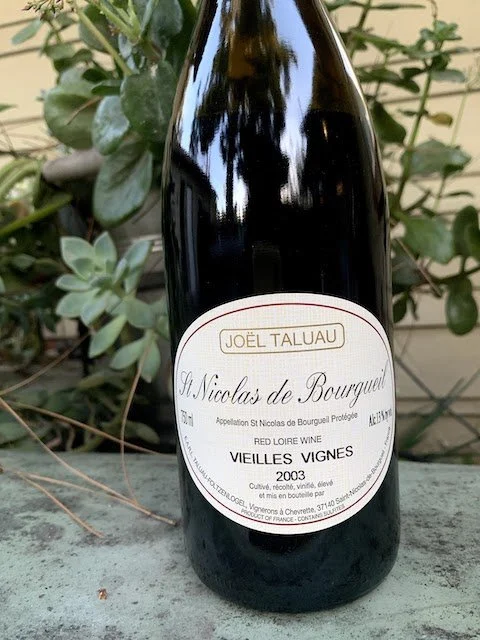
2003 Joël Taluau St-Nicolas-de-Bourgueil Vieilles Vignes $34.99 reflects the warmth of the vintage—richer, rounder, and open-knit.
1997 Joël Taluau St-Nicolas-de-Bourgueil Vieilles Vignes $29.99 leans classic and savory, with tilled earth, tomato leaf, and dried fruit—a real treat for fans of old-school Cab Franc.
And 1989 Joel Taluau St-Nicolas-de-Bourgueil Vieilles Vignes $39.99? Still remarkably structured, with beautiful texture and notes of truffle, capsicum, dried tobacco, and currants. It’s elegant and fully mature, a benchmark for the style.
For the older wines (especially 2003 and earlier), I don’t recommend a long decant. Instead, pull the cork, pour a small glass, and let the bottle breathe for an hour or two. These wines unfold slowly and drink gracefully over several hours.
As a bonus, we’ve also got a handful of magnums from 1978 Joel Taluau St-Nicolas-de-Bourgueil Vieilles Vignes (1.5L) $69.99 and 1982 Joel Taluau "Cuvee au Domaine" St-Nicolas-de-Bourgueil (1.5L) $69.99. Both are pretty special—deep, soulful wines for lovers of aged Loire reds.
We’ll be opening the 1982 at our upcoming Loire tasting on June 28th, so if you’ve ever wondered what mature Cabernet Franc from Bourgueil can taste like, now’s your chance.
The Elegant Chinon of Couly-Dutheil
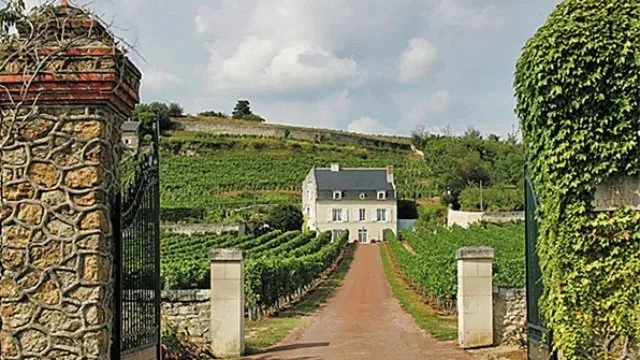
The town of Chinon lies at the intersection of the Vienne and Loire Rivers, where the Vienne has spent centuries carving into the hillsides and depositing alluvial soils across the slopes. While limestone is the foundational bedrock here, you’ll find a patchwork of gravel, sand, clay, and silty-loam depending on where you stand. These soils each lend subtle, yet distinct, character to Cabernet Franc, the star of the region.
One of my longtime favorite producers in Chinon is Couly-Dutheil. Founded in 1921, it remains one of the most respected estates in the central Loire, with over 80 acres of top Chinon vineyards and additional holdings in Saumur and Saumur-Champigny. What sets Couly-Dutheil apart is their understanding and stewardship of Chinon’s diverse terroirs. Their vines span sand and gravel along the Vienne, yielding lighter, fruit-driven styles; siliceous slopes and plateaus that bring elegance and lift; and clay-limestone hillsides, the backbone of Chinon’s most structured and age-worthy wines.
Among these holdings, the jewel is undoubtedly Clos de l’Echo, a 17-hectare monopole (Couly-Dutheil is the sole owner), tucked just behind Chinon’s famed royal fortress. It’s one of the region’s highest south-facing vineyards, set on pure Turonian limestone—the same prized chalk that defines so many of the Loire’s best red terroirs.
If the Loire had a Grand Cru system, this would be one of them. Unlike some Grand Cru Burgundy that sometimes falls short of the name, this one delivers. The winemaking here is restrained and transparent: hand-harvested, native yeasts, fermented in tank, and aged in concrete—no flashy oak, no embellishments. The result? A laser-focused expression of site and grape.
The 2019 Couly Dutheil "Clos de l'Echo" Chinon $39.99 94VN is still young, but already impressive. It’s packed with currants, rosehip, black licorice, and powdered chalk, all wrapped in a taut, mineral frame. Having been lucky enough to taste older vintages, I can say with confidence: this wine ages beautifully, gaining depth and aromatic lift with time. This is a great vintage for Echo, and one that deserves a spot in the cellar.
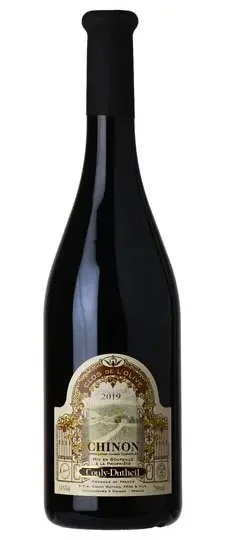
Tucked into the eastern hills of Chinon, the Clos de l’Olive vineyard is smaller—just a third the size of Clos de l’Echo—but no less special. The vines here date back to the 1930s, rooted in clay over Turonian limestone, and the resulting wine has a beautiful purity.
For years, this cuvée was overshadowed by Echo and rarely seen in the U.S., but when I visited the domaine a few years back, I finally had the chance to taste it—and I was instantly smitten. Even better, we tasted a few library releases, and the experience stuck with me. The wines showed an understated grace—a kind of quiet, floral complexity that builds with age.
The 2019 Couly Dutheil "Clos de l'Olive" Chinon $39.99 95VN is no exception. It’s refined, perfumed, and finely detailed. There’s a seamlessness to this wine—silky tannins, lifted aromatics, and precise acidity—that reminds me of the older vintages from the cellar. While still youthful, it already offers layers of character, and it will absolutely evolve with time.
For reference, I once had a bottle of 1989 Clos de l’Olive from the domaine, and it remains one of the finest Chinons I’ve ever had. You won’t have to wait 30 years for the 2019 to show its best—but it might be fun to try.